Layaway Was Never Just a Payment Plan — It Was a Wealth-Building Machine Nobody Noticed

When Walmart quietly killed its layaway program for general merchandise back in 2006, most financial commentators barely noticed. A few consumer advocates grumbled. Retailers shrugged. Credit cards had already won, and layaway felt like a relic — something your grandmother used before Visa made things convenient.
But here's what those commentators missed: for roughly forty years in the middle of the twentieth century, layaway wasn't a consolation prize for people who couldn't get credit. It was a remarkably effective forced savings mechanism that helped millions of working-class American families accumulate real goods, build household stability, and — critically — avoid the debt spiral that would trap their children and grandchildren.
The Sears catalog generation didn't just shop differently. They built wealth differently. And layaway was a bigger piece of that than anyone has properly acknowledged.
How Catalog Layaway Actually Worked
The mechanics were simple enough that a twelve-year-old could explain them, which is partly why they worked so well.
You picked an item from the catalog — a sewing machine, a bicycle, a winter coat, a set of kitchen appliances. You put down a small deposit, usually around ten to twenty percent of the purchase price. Then you made regular payments, typically weekly or monthly, until the balance was paid off. Once you'd paid in full, the item was yours. You took it home. No interest. No fees in most arrangements. No debt.
Sears, Montgomery Ward, and similar catalog retailers ran variations of this system from roughly the 1920s through the 1970s, with peak adoption in the postwar decades. For families living on factory wages, retail salaries, or agricultural income, it was often the only practical way to acquire higher-cost household items without taking on credit.
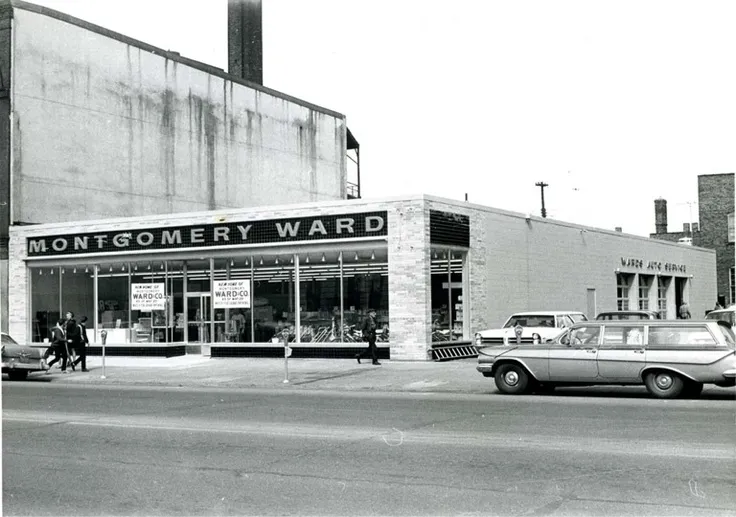 Photo: Montgomery Ward, via i.pinimg.com
What made it function as something closer to a savings account was the timeline. A family saving up for a washing machine might make payments over six to twelve months. During that period, they weren't spending that money on something else. The layaway commitment created a behavioral lock that casual saving rarely achieves.
The Debt Math Nobody Ran at the Time
Here's the part that should make you stop and think.
A family in 1955 who used layaway to buy a refrigerator over nine months paid exactly what the refrigerator cost. A family in 1985 who put the same refrigerator on a department store credit card and made minimum payments for two years paid significantly more — sometimes thirty to fifty percent more when interest was fully calculated. The layaway family owned their appliance outright. The credit card family owned a debt with an appliance attached.
Multiply that dynamic across a household's major purchases over a decade, and the divergence in net financial position becomes striking. Researchers studying mid-century household finances have noted that working-class families in the 1950s and early 1960s carried debt loads that look almost quaint by contemporary standards. Mortgage debt existed, certainly. But consumer debt — the revolving, interest-accruing kind — was far less common and far less normalized than it would become.
Layaway wasn't the only reason for that difference. But it was part of the infrastructure that made spend-only-what-you-have a practical reality rather than just a moral preference.
Why Credit Cards Didn't Just Replace Layaway — They Reframed It
When credit cards began their serious expansion into mainstream American consumer life in the late 1960s and through the 1970s, the pitch was liberation. No more waiting. No more saving up. You could have the thing now and deal with the payment later. Convenience became the dominant value, and layaway started to look like a punishment for not having good credit.
But that framing obscured something important. The wait that layaway required wasn't a bug — it was the feature. The delay between wanting something and owning it was exactly what created the savings discipline. Eliminating the wait didn't just make purchasing faster. It made it structurally impossible to avoid accumulating debt on everyday consumer goods.
Banking industry lobbying through the 1970s and 1980s also quietly worked to position credit as the modern, aspirational option. Retailers who might have resisted — because layaway had no interchange fees and required no banking partnerships — found themselves competing with stores that offered instant credit approval. The competitive pressure was real.
Layaway didn't die because consumers rejected it. It died because the financial architecture around retail purchasing was deliberately rebuilt to make credit the path of least resistance.
The Quiet Comeback and What It Tells Us
Interestingly, layaway never fully disappeared. Walmart brought it back in 2011, initially for the holiday season, after consumer demand became impossible to ignore. Kmart kept a version running through the lean years. And in the digital age, buy-now-pay-later services like Afterpay and Klarna have essentially reinvented layaway's installment logic — though often with fees and interest structures that the original programs didn't carry.
There's also a grassroots version thriving in communities that never fully abandoned the concept. Independent retailers in many working-class neighborhoods still offer informal layaway arrangements. Some churches and community organizations run Christmas layaway funds that operate almost identically to the mid-century catalog model.
The appetite for a no-debt, no-interest installment option never went away. The mainstream financial industry just spent several decades making it seem unnecessary.
The Vault Takeaway
Layaway looks like a historical footnote. But examined closely, it was a genuinely sophisticated financial tool — one that aligned purchasing behavior with actual savings capacity, eliminated interest costs entirely, and helped ordinary families build household wealth without touching a bank.
The families who used Sears layaway to furnish their homes in 1958 weren't behind the times. They were, by the financial outcomes, ahead of them. The credit card generation that replaced them is still paying off the interest on that particular upgrade.
Sometimes the old way wasn't primitive. Sometimes it was just inconvenient for the people trying to sell you something.