The Month America's Hardest-Hit Families Stopped Spending Everything — And Somehow Came Out Ahead
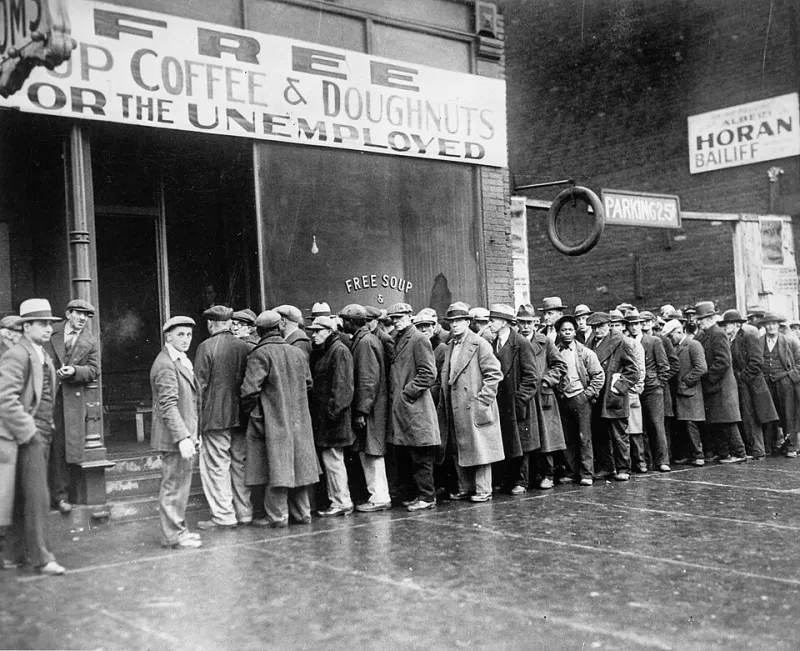
Photo: Unknown authorUnknown author or not provided, Public domain, via Wikimedia Commons
The Month America's Hardest-Hit Families Stopped Spending Everything — And Somehow Came Out Ahead
Somewhere in Cleveland in 1933, a group of women sitting around a kitchen table made a decision that sounds almost absurd by modern standards: for the entire month of February, none of them would spend a single discretionary dollar. No new clothes. No restaurant meals. No movie tickets. No small luxuries of any kind. And whatever money they saved — every last cent — would go into a shared pot to help whichever member was closest to losing her home.
They weren't economists. They weren't financial planners. They were neighbors trying to survive the worst economic collapse in American history. And what they invented, without knowing it, was one of the most psychologically sophisticated debt-reduction tools ever tried.
The Mechanics of a Financial Fast
The frugality clubs that emerged in Cleveland, Pittsburgh, Detroit, and other hard-hit industrial cities during the 1930s varied in their specifics but shared a core structure that was almost ingeniously simple.
Members — usually between eight and twenty families — would agree to a defined "zero-spend period," typically one month. During that window, spending was frozen on anything beyond genuine necessities: rent, utilities, basic groceries, and medical costs. Everything else stopped.
At the end of the month, each member tallied what they hadn't spent compared to a typical month. That surplus — sometimes just a few dollars, sometimes twenty or thirty — went into the group's collective fund. The fund was then directed toward whichever member faced the most urgent financial crisis: a debt payment, a utility shutoff notice, back rent owed to a landlord who was also, not infrequently, a member of the same club.
The system worked partly because of math and partly because of something harder to quantify: mutual accountability.
Why the Social Structure Mattered More Than the Money
Anyone who has tried to cut their spending alone knows how quickly the resolve evaporates. You skip the restaurant for three days, then a stressful Tuesday arrives and suddenly you've ordered delivery and convinced yourself it was a one-time thing.
The frugality clubs solved this problem through community pressure — and they did it with surprising sophistication. Many clubs held weekly check-ins, not to shame members who slipped, but to troubleshoot. If someone was struggling to avoid a particular expense, the group would problem-solve together. A neighbor might share a recipe that replaced a store-bought staple. Another might offer to trade a skill — sewing, car repair, childcare — that eliminated the need to spend money on a service.
Spending became a collective project rather than a private struggle. And that shift in framing turned out to be enormously powerful.
Some clubs kept public ledgers, similar to the rotating savings circles (ROSCAs) that immigrant communities had long used, where every member's contribution and withdrawal was visible to the group. Transparency, it turned out, was a better accountability mechanism than willpower.
The Quiet Numbers
Documented records from these clubs are scattered — they weren't exactly filing annual reports — but local newspaper accounts and social work studies from the 1930s captured enough detail to sketch the results.
In some Pittsburgh neighborhoods, frugality clubs reported that participating families reduced monthly discretionary spending by 40 to 60 percent during zero-spend months. For families operating on Depression-era incomes that might mean the difference between making a rent payment or not. Several documented cases show club funds directly preventing evictions that would otherwise have displaced families with no safety net to catch them.
The clubs also produced a secondary benefit nobody had planned for: members got genuinely better at identifying what they actually needed versus what they habitually bought. Post-freeze, many families maintained lower spending levels than before — not because they were still in crisis mode, but because the month had broken automatic spending habits that they hadn't even noticed.
The Revival Nobody Is Talking About
Here's where the story gets interesting for anyone paying attention in 2024.
A growing movement of Americans — scattered across Reddit communities, personal finance forums, and small online groups — has quietly revived the zero-spend month concept, sometimes without knowing its Depression-era roots. Search "no-spend month challenge" and you'll find thousands of participants logging their results, sharing their rules, and holding each other accountable in comment threads that function remarkably like those kitchen table meetings from ninety years ago.
The modern version has adapted for contemporary life. Participants typically carve out exceptions for subscriptions they consider essential, define "discretionary" for their own circumstances, and use apps to track their progress in real time. But the core mechanic — a defined period, a community of accountability, and a collective goal — is almost identical to what those Cleveland women invented out of necessity.
Some online communities have added a twist the 1930s clubs would have recognized immediately: members who complete the month successfully contribute a portion of their savings to a shared fund that helps a member in the group who's dealing with a financial emergency. The digital lending circle, it turns out, looks a lot like the analog one.
What the Experiment Reveals
The frugality clubs of the Depression weren't just a survival tactic. They were a working proof of concept for something behavioral economists have spent decades trying to engineer: a system that makes saving feel socially rewarding rather than personally punishing.
When cutting back is something you do with your neighbors instead of something you do alone in secret, it stops feeling like deprivation and starts feeling like participation. That's not a small distinction. It's probably the entire reason these clubs worked when individual willpower routinely fails.
We've built an enormous financial industry around helping people save more and spend less. Apps, automated transfers, budget spreadsheets, financial coaches. Most of it works for some people some of the time.
But a circle of neighbors with a shared ledger and a shared goal? That worked for a lot of people when everything else had already failed. It might be worth remembering why.