The Pawnshop Was the Real Bank: What Early 20th-Century Brokers Understood About Money That Wall Street Still Ignores
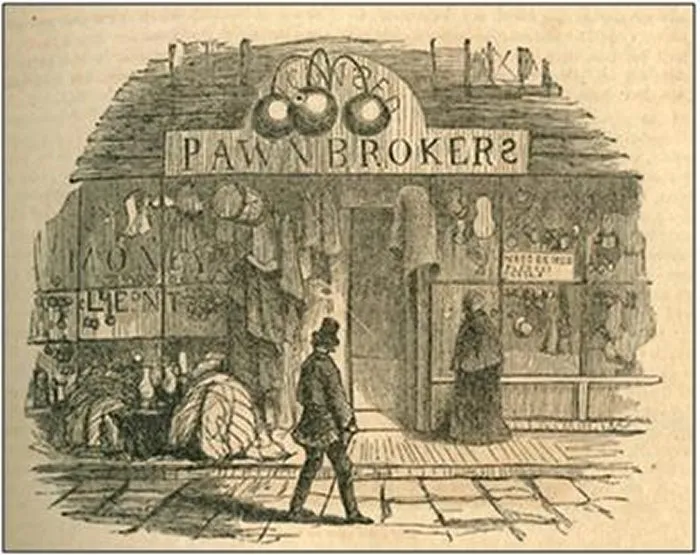
Photo: vintage pawnshop storefront 1920s city street three gold balls sign, via www.ancientpages.com
On a Tuesday morning in November 1908, a steelworker in Pittsburgh walked into a shop on Penn Avenue and handed over his wife's gold brooch. He needed $3.50 to cover rent until payday. He'd be back in two weeks. He'd done this before. The broker knew him, knew the brooch, knew the man's employer and his pay schedule. The transaction took four minutes.
No credit check. No collateral assessment beyond the object in hand. No judgment. Just a practical exchange between two people who both understood exactly what was happening and why.
This was, by any functional definition, banking. We just stopped calling it that.
The Seasonal Logic That Banks Refused to See
Formal banks in the early 1900s were structured around a particular kind of borrower: businesses with receivables, landowners with deeds, merchants with inventory. The working-class American — paid weekly, employed seasonally, living without a savings cushion — was largely invisible to the commercial banking system, not because they weren't creditworthy, but because the bank's tools couldn't measure them.
Pawnbrokers didn't have that problem. Their entire business model was built around the reality of how working people actually moved through money across a calendar year.
A skilled pawnbroker in an industrial city understood that winter was tight — heating costs up, hours sometimes cut, holiday spending straining budgets. They knew that spring brought back overtime at the mills and the docks. They knew that a family pawning a sewing machine in January almost certainly intended to redeem it in March, and that pricing the loan accordingly was both good business and good community relations.
This wasn't charity. It was applied financial intelligence of a very high order.
What the Brooch Was Really Worth
One of the most underappreciated skills a pawnbroker developed was something modern finance calls liquidity-adjusted valuation — though no pawnbroker in 1910 would have used that phrase.
When a family brought in a piece of jewelry or a musical instrument or a set of tools, the broker wasn't just assessing the object's market value. He was assessing its personal value, its redemption probability, and the borrower's likely timeline. A gold brooch worth $12 at a jeweler's counter might yield a $4 loan — not because the broker was being predatory, but because the loan had to account for storage, insurance against the item not being redeemed, and the real cost of eventually liquidating an item in a secondhand market.
Pawnbrokers who got those calculations wrong didn't stay in business. The ones who stayed understood asset valuation in ways that most bank loan officers — who dealt in standardized collateral like property and equipment — never needed to develop.
Critically, they also understood the difference between distress and disaster. A family pawning a watch was usually managing a temporary cash gap, not spiraling into insolvency. A family pawning everything they owned, repeatedly, without redeeming anything, was a different situation — and experienced brokers recognized the distinction and sometimes, informally, directed people toward other resources.
Why the Banks Wanted Them Gone
By the 1910s and 1920s, a coordinated campaign to regulate pawnbroking out of respectability was well underway in American cities. The arguments were framed in the language of consumer protection: pawnbrokers charged high rates, they accepted stolen goods, they preyed on desperate people.
Some of those criticisms had merit. There were exploitative operators. But the campaign against pawnbroking was never purely about consumer welfare — it was also, quite plainly, about market share.
Commercial banks and the newly emerging consumer finance companies wanted access to the working-class borrower that pawnbrokers had been serving for decades. The problem was that the pawnbroker's model — collateral-based, relationship-informed, flexible — was actually more appropriate for that borrower than anything the formal financial system was offering. Replacing it required discrediting it.
Municipal licensing requirements, interest rate caps set too low to cover actual operating costs, and zoning restrictions that pushed shops out of residential neighborhoods all chipped away at the industry. Progressive-era reformers, genuinely concerned about exploitation, often became unwitting allies in a campaign that ended up leaving working families with fewer good options, not more.
The Rehabilitation That Never Fully Came
Pawnbroking survived, of course. There are still roughly 11,000 pawnshops operating in the United States today, and their customer base remains largely the same demographic that walked through those Penn Avenue doors in 1908 — people managing cash flow gaps without access to cheap credit.
What didn't survive was the cultural legitimacy. The pawnshop became, in the popular imagination, a symbol of poverty and desperation rather than a practical financial tool. That reframing was deliberate, and it was successful, and it cost working families enormously — pushing them toward payday lenders, rent-to-own schemes, and overdraft fees that are, by any honest measure, far more expensive and far less transparent than what the old brokers were offering.
The steelworker who pawned his wife's brooch in 1908 paid something like 3 percent a month on a two-week loan. A payday lender today charges the equivalent of 300 to 400 percent annually on a similar transaction.
Somewhere along the way, we decided the pawnbroker was the predator. The math suggests we had it exactly backwards.