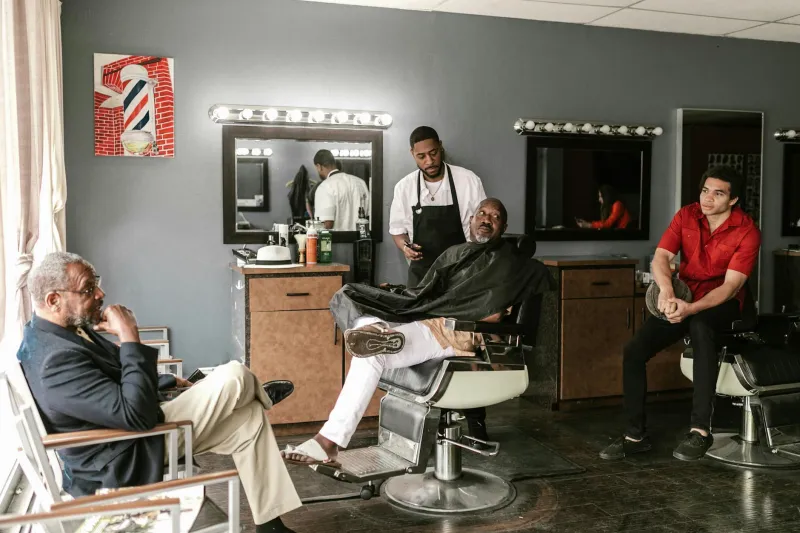
In 1923, if you wanted to buy stocks in Pittsburgh, you didn't need to call a fancy broker on Wall Street. You could just walk into Tony Marcelli's barbershop on Carson Street, get a shave, and leave with shares in Westinghouse Electric. While your hair was being cut, Tony would scribble your order on a slip of paper, and by the time you left, you owned a piece of American industry.
This wasn't some back-alley scam. Tony's barbershop, like hundreds of similar operations across industrial America, was part of a vast network of neighborhood stock exchanges that gave ordinary workers their first taste of equity ownership — decades before anyone dreamed of apps that let you buy fractional shares with your spare change.
When Main Street Had Its Own Wall Street
Between 1900 and 1930, America's industrial boom created an unlikely phenomenon: grassroots stock markets that operated out of the most mundane locations imaginable. Barbershops, saloons, corner stores, and even pool halls became unofficial trading floors where factory workers, immigrants, and small business owners could buy shares in local companies.
These "curb markets" — named after the New York Curb Market that literally operated on the street outside the NYSE — weren't regulated like today's exchanges. Instead, they ran on trust, community knowledge, and surprisingly sophisticated word-of-mouth networks. A steelworker in Gary, Indiana, might hear about a promising local foundry from his barber, who heard about it from the company's bookkeeper during his weekly trim.
The mechanics were elegantly simple. Local "customer's men" — the predecessors to today's financial advisors — would set up shop in neighborhood gathering places. They'd collect orders throughout the week, then execute trades through connections to larger exchanges or directly with companies. No minimum investments, no complicated paperwork, just cash-and-carry capitalism at its most democratic.
The Numbers Tell a Remarkable Story
By 1929, an estimated 1.5 million Americans owned stocks through these neighborhood exchanges — nearly 10% of all stockholders in the country. In industrial cities like Detroit, Cleveland, and Pittsburgh, curb market participation rates among blue-collar workers reached as high as 30%.
What's even more remarkable is what they were buying. Unlike today's retail investors who often chase meme stocks or follow social media tips, these neighborhood traders focused heavily on local companies they understood. A Ford assembly line worker would buy Ford stock. A steel mill employee would invest in steel companies. They had insider knowledge — not the illegal kind, but the practical understanding that comes from actually making the products.
This local focus paid off. Research by financial historian Julia Ott found that curb market investors in the 1920s actually outperformed the broader market by an average of 2.3% annually. They were less likely to panic during downturns and more likely to hold onto fundamentally sound companies during temporary setbacks.
Why Wall Street Killed the Competition
The crash of 1929 changed everything, but not in the way you might expect. While the economic devastation certainly hurt neighborhood exchanges, the real death blow came from regulation. The Securities Exchange Act of 1934 imposed strict licensing requirements, mandatory record-keeping, and capital requirements that effectively outlawed most curb market operations.
The stated goal was investor protection — preventing another 1929. But the practical effect was to centralize stock trading in the hands of large, established firms. Your neighborhood barber couldn't afford the compliance costs of becoming a registered broker-dealer. The local saloon keeper wasn't going to file quarterly reports with the SEC.
Within a decade, the grassroots stock markets that had served millions of Americans simply vanished. Investing became the exclusive domain of the wealthy and their professional intermediaries on Wall Street.
The Century-Long Detour
For the next 80 years, American finance forgot the lessons of the barbershop stock markets. Investing remained expensive, intimidating, and largely inaccessible to ordinary workers. Minimum account balances, high commission fees, and complex products kept most Americans on the sidelines.
It wasn't until the arrival of commission-free trading apps like Robinhood in 2013 that we began to rediscover what Tony Marcelli and thousands of other neighborhood brokers had figured out a century earlier: ordinary people want to own pieces of the companies they work for and buy from, and they'll make surprisingly smart choices if given the chance.
What We Lost and Found Again
Today's fractional share investing and social trading platforms are essentially high-tech versions of the old curb markets. The community knowledge that once flowed through barbershops now moves through Reddit forums and Discord channels. The local focus has been replaced by sector-specific communities — gamers buying gaming stocks, Tesla owners buying Tesla shares.
But something important was lost in that century-long detour. The old neighborhood exchanges weren't just about making money; they were about making capitalism tangible and democratic. When your barber was also your broker, investing felt less like gambling and more like participating in your community's economic future.
As we celebrate the democratization of investing through technology, it's worth remembering that we've been here before. The barbershop stock markets of the 1920s proved that ordinary Americans are perfectly capable of making smart investment decisions when given simple tools and trusted guidance. It just took us a hundred years to remember that lesson.