How Fish Workers Cracked the Code on Saving Money When You Never Know Your Next Paycheck

In the bustling fish markets of early 1900s Boston, a peculiar ritual played out every Friday afternoon. Workers who'd just earned their weekly wages would immediately hand a portion back to their employers — not as payment for anything, but as forced savings for the lean months ahead.
This wasn't charity or exploitation. It was financial engineering at its most practical, designed by people who understood something most Americans are just rediscovering: when your income swings wildly, traditional saving advice doesn't work.
The Brutal Math of Seasonal Work
Fish market workers faced an income problem that would stump modern financial advisors. During peak season — roughly May through October — they might earn $25 a week (equivalent to about $800 today). Come winter, when fishing boats stayed docked and fresh catches dwindled, that same worker might earn $3 a week, if anything at all.
Saving 10% of income, the standard advice then and now, meant setting aside $2.50 during good weeks to cover winter shortfalls of $22. The math simply didn't work. Workers needed a system that could handle extreme income volatility, not gentle fluctuations.
Enter the "holdback system" — a deceptively simple innovation that solved the seasonal worker's financial puzzle.
The Fishmonger's Financial Innovation
The holdback worked like this: during peak season, employers automatically retained 20-30% of each worker's pay in a separate account. This wasn't a loan or advance — it was the worker's own money, held in trust. Come winter, workers could draw from their accumulated holdback to supplement meager off-season earnings.
What made this brilliant wasn't just the forced savings aspect. The system included built-in protections that modern apps are only now rediscovering:
Graduated Release: Workers couldn't access their entire holdback at once. Instead, they received weekly allowances calculated to last through the typical off-season. This prevented the all-too-human tendency to blow through savings in a few spectacular weeks.
Emergency Overrides: Serious emergencies — medical bills, family crises, home repairs — could trigger immediate access to holdback funds, but only with approval from a worker committee. Peer review kept frivolous requests in check while ensuring genuine emergencies got covered.
Employer Matching: Many fish market owners added a small bonus to holdback accounts — typically 5-10% — as an incentive for participation. This early "employer matching" helped offset the psychological pain of reduced take-home pay during good times.
Why It Worked When Willpower Failed
The holdback system succeeded where individual discipline failed because it removed the moment of choice. Workers never saw the money they were "saving" — it disappeared before they could spend it. This eliminated the daily internal negotiations that doom most saving attempts.
More importantly, the system created social reinforcement. Everyone participated, so living below your gross income became normal rather than a sign of financial constraint. Workers competed to build larger holdback balances, turning saving into a community achievement rather than individual sacrifice.
The peer approval process for emergency withdrawals added another layer of accountability. Workers had to justify major expenses to colleagues who understood their situation intimately. This prevented the rationalization spiral that turns "emergencies" into routine spending.
The Regulatory Steamroller
By the 1930s, the holdback system was disappearing under pressure from labor regulations and banking laws. New Deal legislation, designed to protect workers from exploitation, classified holdback arrangements as potentially coercive. Banks pushed for all wage payments to flow through formal financial institutions, arguing that employer-managed savings accounts lacked proper oversight.
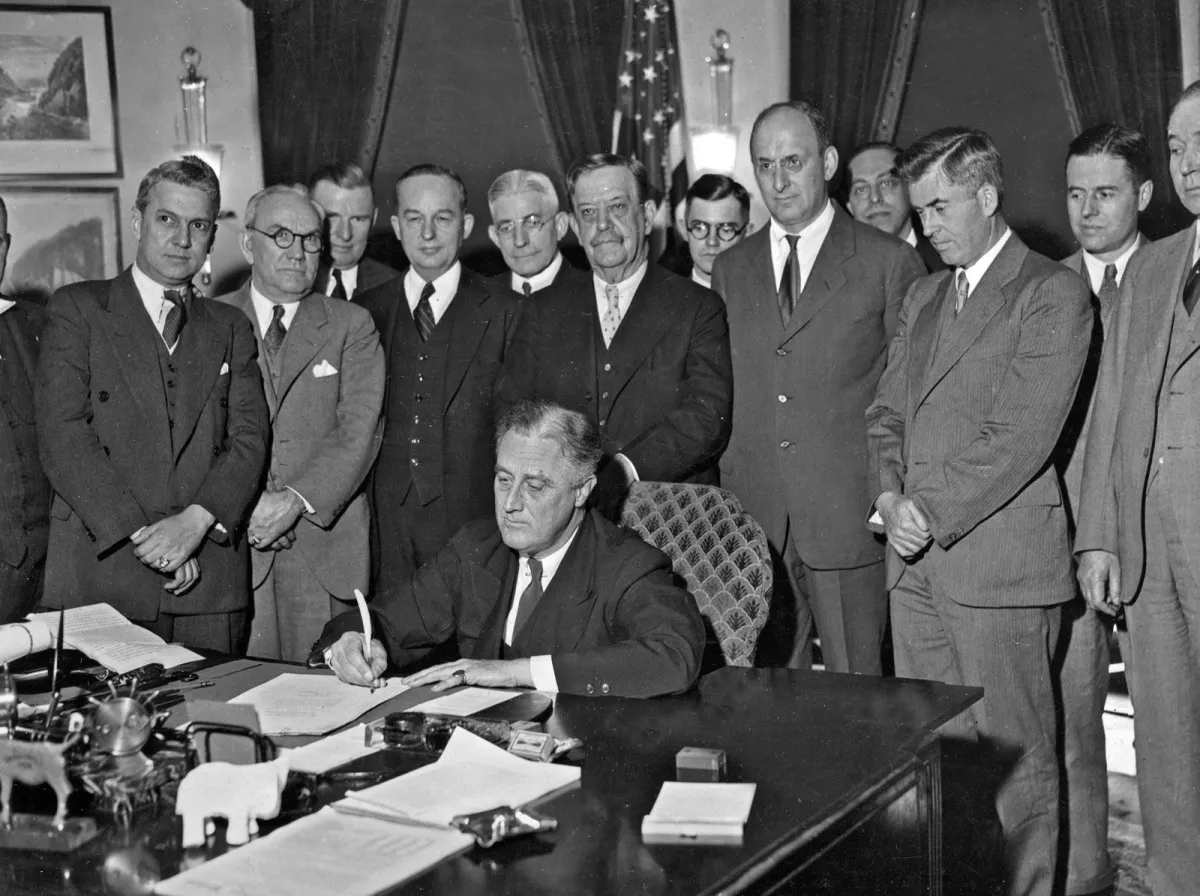 Photo: New Deal, via cdn.britannica.com
The irony was thick: regulations meant to help workers inadvertently destroyed a system that had successfully helped thousands of families weather economic uncertainty for decades. Workers gained legal protections but lost a financial tool that actually worked for their chaotic income patterns.
Silicon Valley's Accidental Rediscovery
Fast-forward to 2024, and tech startups are "disrupting" personal finance with innovations that would sound familiar to any 1920s fish worker. Apps like Qapital and Digit automatically transfer small amounts from checking to savings accounts. Others, like Acorns, round up purchases and invest the difference.
More directly parallel are apps targeting gig workers — Uber drivers, DoorDash couriers, freelance designers — who face the same income volatility that plagued seasonal fish workers. SteadyPay and similar services analyze earning patterns and automatically set aside larger percentages during high-income periods to smooth out the inevitable low periods.
The most sophisticated versions even include emergency override features and peer accountability mechanisms that mirror the old holdback system's social components. What's missing is the historical context — these apps are presented as cutting-edge innovation rather than digital versions of century-old solutions.
Why Old Wisdom Beats New Apps
The fish workers' holdback system had advantages that modern apps struggle to replicate. Most importantly, it operated at the employer level, meaning everyone participated automatically. Today's voluntary savings apps suffer from selection bias — they mainly attract people already motivated to save.
The social accountability component also worked better in tight-knit communities where financial reputation mattered for future employment and business relationships. App-based accountability relies on gamification and notifications, which feel less consequential than explaining your emergency withdrawal request to coworkers who might become future references.
Perhaps most crucially, the holdback system was designed by and for people who actually lived with extreme income volatility. Modern apps are typically built by well-paid tech workers for theoretical users, leading to features that sound good in focus groups but miss the psychological realities of financial uncertainty.
The Bigger Picture
The fish workers' holdback system represents something larger than a clever savings hack. It was community-based financial engineering — a solution that emerged from the people who faced the problem, rather than being imposed by outside experts.
As the gig economy creates new forms of income volatility, there's wisdom in looking backward as well as forward. The most sophisticated fintech app still can't replicate the social fabric that made the holdback system work, but it can learn from the practical insights embedded in the design.
Sometimes the most innovative solution isn't the newest technology — it's the oldest wisdom, finally getting the recognition it deserved all along.